
PRISM
Photon Residue Imaging and Spectral Memory
The Past Is Never Truly Gone.
A fictional breakthrough in optical reconstruction with profound consequences for truth, privacy and power.
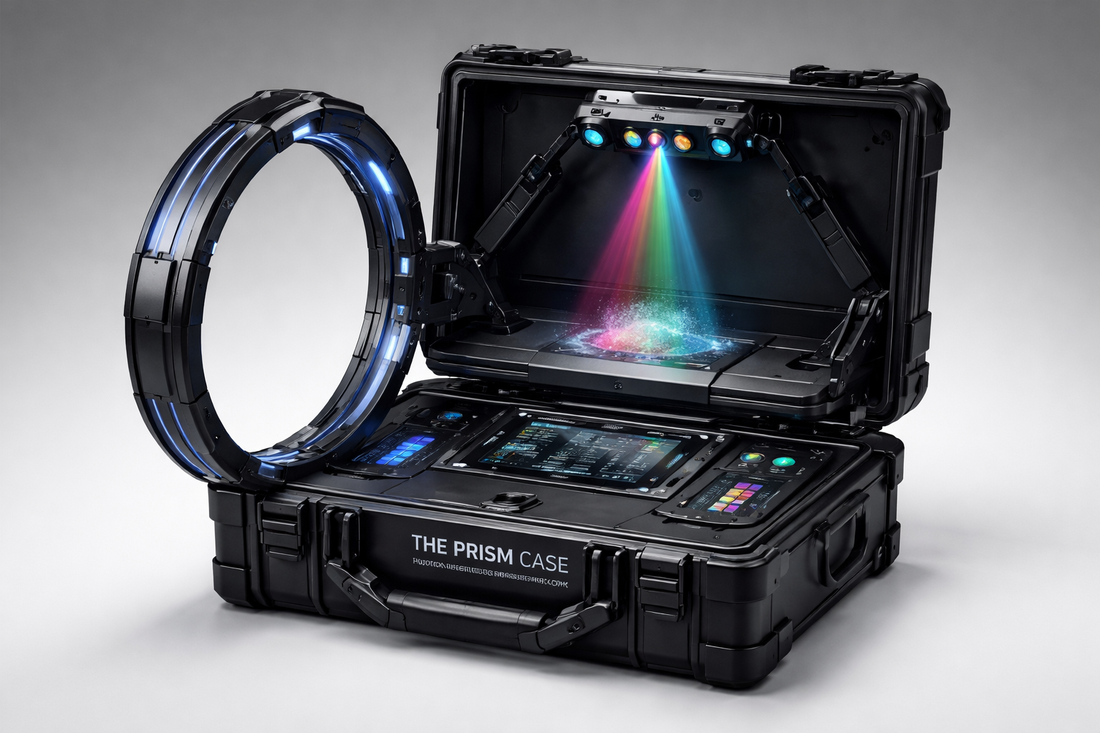
Photon Residue Imaging and Spectral Memory. In the world of The Colour of Truth, Dr Peter Hargreaves builds PRISM, an experimental reconstruction engine capable of producing visual representations of past events. It is not a time machine.
Can matter remember light?
Real optical physics describes how light is absorbed, reflected and scattered as it interacts with matter. The novel introduces a fictional extension: that materials can retain faint, decaying signatures of previous light interactions that can be interrogated and reconstructed. There is no established scientific method for recovering arbitrary historical scenes from walls.
How PRISM operates in the novel
01 — Surface selection
The operator identifies a suitable material surface.
02 — Time-depth calibration
The target period is selected, while the condition of the surface constrains how far into the past reconstruction may reach.
03 — Spectral scanning
Calibrated light interrogates the target.
04 — Image reconstruction
Processed information begins to emerge as incomplete luminous forms and flickering scenes.

05 — Observation
The recovered visual representation may be observed and recorded.
Even the past has its secrets
Materials behave differently. Damage, contamination, repairs, paint, reflections and environmental disturbance may compromise the data. Reconstruction is imperfect; instability, equipment overheating and other operational constraints restrict what can be seen.
A crucial limitation: the original PRISM instrument does not recover historical speech. Future audio reconstruction is a possibility discussed by its inventor, not a function established for the device.
If you could see the past, would you want to?
Truth and justice
Could reconstructed images transform criminal investigations—or create new disputes about evidence?
History rewritten
What happens when historical narratives meet apparently direct observation?
Privacy
What becomes of private life when walls might disclose what once occurred behind them?
Power and control
Who could be trusted to govern a device with such consequences?
Human memory
What if recalled events and reconstructed scenes disagree?
The burden of truth
Does the ability to reveal a secret justify its exposure?
The PRISM Research Files
Explore additional images, diagrams and research notes from the fictional world of the novel.
Light and Matter
Absorption, reflection and scattering are genuine physical phenomena. Recovering arbitrary past scenes from surfaces is the novel's fictional premise.
Spectral Residue
The speculative model proposes that materials retain faint signatures of earlier light interactions.
Reconstruction and Limits
The fictional PRISM system generates imperfect visual reconstructions. It does not recover historical speech.